EVOLUTION OF THE HOBBY

RC History Timeline

A decade-by-decade look at the models, engineering shifts and landmark releases that shaped radio control. Every milestone below links to its full archive record and a verifiable source.

A Brief History of Radio Control

From early radio experiments to the modern R/C world.

From Radio Experiments to R/C Models

The history of radio-controlled modelling is a story of experimentation, engineering and continual miniaturisation. What began as specialised radio technology in the first half of the twentieth century gradually developed into one of the world’s most technically diverse modelling hobbies.
The foundations of radio control emerged during the 1930s, when experimenters began demonstrating that model aircraft and boats could be controlled remotely using radio signals. These early systems were large, expensive and extremely limited by modern standards. Vacuum tubes, heavy batteries and primitive transmitters meant that radio control was largely the territory of dedicated engineers and technically accomplished hobbyists.
Development accelerated during and after the Second World War as radio, electronics and control technology improved dramatically. By the 1950s, radio-controlled model aircraft were becoming increasingly practical. Early systems generally offered only limited control before progressively more sophisticated multi-channel equipment became available.
The introduction of transistors was transformative. Radio equipment became smaller, lighter, more reliable and increasingly affordable.

The R/C Revolution of the 1960s

The 1960s represented an important transition from experimental radio control toward recognisable modern hobby R/C.
Proportional radio systems allowed the movement of a transmitter stick to correspond progressively with the movement of a servo. Instead of simply commanding full-left or full-right, an operator could exercise considerably finer control.
At the same time, enthusiasts were beginning to apply increasingly sophisticated radio equipment to cars. One landmark was the 1/8-scale Ferrari 250LM produced by the Italian company Elettronica Giocattoli (El-Gi) in 1966, frequently identified in histories of the hobby as the first commercially available radio-controlled model car.

The Birth of Modern R/C Cars

By the late 1960s and early 1970s, commercially produced R/C cars began to appear in greater numbers. European, American and Japanese manufacturers helped establish an increasingly sophisticated market for on-road and off-road models.
The technology was still considerably different from today’s equipment. Many cars relied on mechanical speed controls operated by servos, comparatively heavy radio equipment and relatively simple battery technology.
Yet the essential architecture of the modern R/C car was emerging: transmitter, receiver, servo, steering, motor or engine, drivetrain, suspension and tyres. The foundations had been laid for the extraordinary expansion that followed.

Japan and the Golden Age

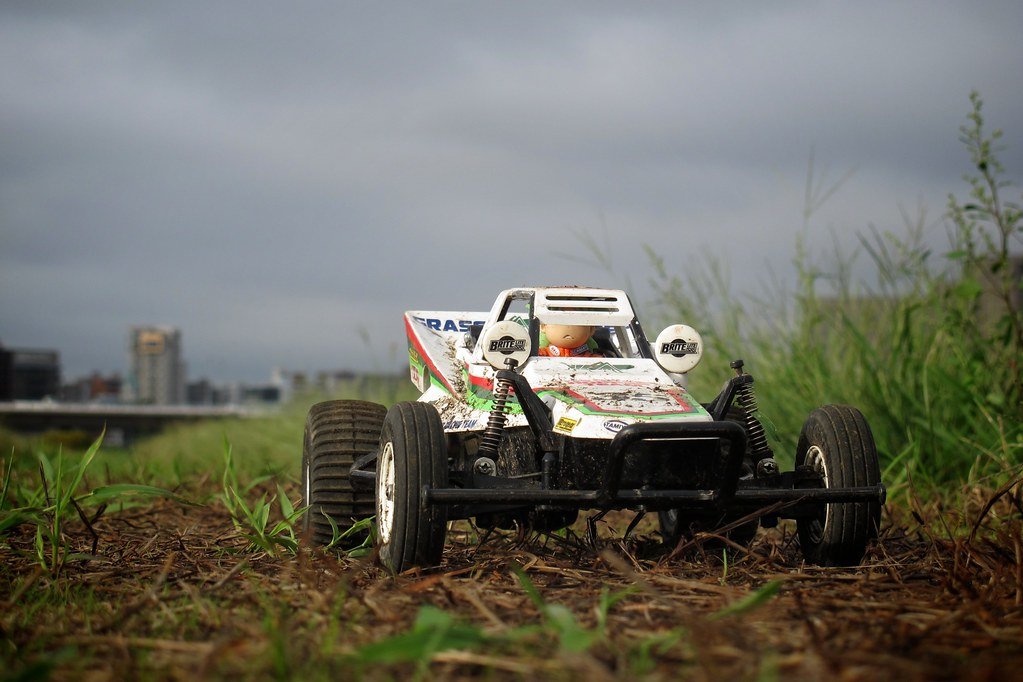
The 1970s and 1980s transformed R/C cars from a specialist pursuit into an international hobby. Japanese manufacturers became particularly influential, combining sophisticated engineering with increasingly accessible kits.
A defining moment occurred in 1976. On 4 December 1976, Tamiya released kit 58001, the Porsche 934 Turbo RSR, establishing the beginning of the numbered R/C series that would ultimately become one of the most recognisable catalogues in the hobby. It is the machine from which the RC Classics First 100 chronology begins.
The early Tamiya machines were followed by increasingly ambitious designs. Scale realism remained important, but engineering sophistication rapidly increased. The Sand Scorcher, Rough Rider, Frog, Hornet, Hotshot, Bruiser, Clod Buster, Avante and Egress, among many others, eventually became recognised as landmarks of their respective eras.

Kyosho and Competition Engineering

Kyosho was another major force in this development. Its history extends back to 1963, and the company became an important producer of R/C cars, aircraft, boats and other models. Kyosho’s historical material identifies 1970 as the year it began selling its DASH 1 R/C car.
During subsequent decades, machines such as the Scorpion, Tomahawk, Optima, Ultima and Inferno families helped establish Kyosho’s reputation for competition-oriented engineering.
The rivalry and innovation among Japanese, American and European manufacturers produced rapid improvements in suspension geometry, four-wheel drive, differentials, tyres, chassis materials, dampers and drivetrains.

The Buggy Boom

Off-road R/C racing became one of the defining features of the 1980s. Purpose-designed buggies allowed R/C cars to leave smooth parking lots and prepared tracks for dirt, jumps and increasingly sophisticated off-road circuits.
Competition encouraged manufacturers to experiment with independent suspension, oil-filled dampers, increasingly sophisticated differentials, belt, chain and shaft four-wheel-drive systems, lightweight chassis materials, racing tyres, ball bearings and extensive performance option systems.
R/C was becoming miniature motorsport.

Electronics Transform the Hobby

Another revolution was occurring inside the cars. Early mechanical speed controllers gradually gave way to electronic speed controls (ESCs). Radio equipment became smaller and more reliable, while rechargeable battery technology improved dramatically.
Brushed motors remained dominant for many years, particularly the ubiquitous 540-size motor, but competition encouraged increasingly powerful modified motors. Nickel-cadmium batteries were followed by nickel-metal hydride technology and eventually lithium-polymer (LiPo) batteries.
The widespread adoption of brushless motors and modern ESCs transformed performance again. At the same time, 2.4 GHz radio systems largely eliminated the traditional frequency-crystal management that generations of R/C racers had once considered normal.
A modern R/C system can deliver levels of reliability, power and control that would have seemed extraordinary to an enthusiast in 1976.

From Cars to an Entire R/C World

Radio control has never been limited to cars. The technology developed across aircraft, helicopters, boats, racing yachts, tanks, trucks, construction equipment, motorcycles, submarines, rock crawlers, drones and multirotors.
Scale modelling and radio-control engineering increasingly converged. A modern 1/14 truck can incorporate working lighting, sound, transmissions and trailers. A 1/16 tank can reproduce turret rotation, gun elevation, recoil, sound and track movement. Racing yachts reproduce sophisticated sail-control systems, while modern competition cars incorporate extraordinarily refined suspension and drivetrain technology.
The fundamental idea, however, remains remarkably similar to that of the early experimenters: controlling a machine remotely by radio.
The Vintage R/C Movement

As the hobby matured, something unexpected happened: the old models became collectible.
Cars that had originally been purchased to race, jump and modify began to be recognised as important examples of industrial design and miniature engineering. Original boxes, instruction manuals, mechanical speed controls, wheels, tyres, bodies, decals and even individual screws became important to collectors seeking historically correct restorations.
Manufacturers also recognised this interest. Numerous historically significant R/C models have consequently returned as re-releases, anniversary editions and modern interpretations.
The hobby therefore developed a second history: the history of preserving its own history.

R/C Today

Modern radio control now encompasses everything from inexpensive ready-to-run models to extremely sophisticated competition machines and museum-quality scale reproductions.
Computerised transmitters, telemetry, brushless power systems, LiPo batteries, CNC-machined components, carbon fibre, sophisticated differential systems and highly adjustable suspension have dramatically changed what an R/C model can do.
Yet vintage machines remain enormously appealing precisely because their technology is visible. A mechanical speed controller can be understood by watching it move. A differential can be disassembled. A suspension system can be examined. A chassis records the engineering philosophy of its period.
That mechanical honesty is one of the qualities that makes classic R/C worth preserving.

Why RC Classics Exists

RC Classics sits at the intersection of these two worlds. We celebrate modern R/C technology while preserving the machines that made it possible.
The purpose of the archive is therefore not merely to catalogue old models. It is to document the development of R/C engineering through the machines themselves: the manufacturers that created them; the engineers who designed them; the racers and enthusiasts who used them; the technology that made them possible; and the collectors and restorers who preserve them today.
From the earliest radio-control experiments of the twentieth century, through the pioneering commercial cars of the 1960s, the explosion of Japanese R/C engineering during the 1970s and 1980s, the racing revolution of subsequent decades and today’s extraordinary machines, radio control represents nearly a century of ingenuity in miniature.
RC Classics exists to preserve that story.
Preserve the machines. Document the engineering. Record the history. Keep the classics running.
EXPLORE OUR ARCHIVE, DECADE BY DECADE

Real milestones from the RC Classics collection

1970s

Electric RC becomes a defining hobby category

Early Tamiya competition cars and buggies, and the arrival of practical proportional radio systems.
1976
Tamiya

Porsche 934 Turbo RSR

Part of the Tamiya First 100 collection. Full technical record pending research.
1977
Tamiya

Martini Porsche 935 Turbo

Part of the Tamiya First 100 collection. Full technical record pending research.
1977
Tamiya

Tyrrell P34 Six Wheeler

Part of the Tamiya First 100 collection. Full technical record pending research.
1977
Tamiya

XR311 Combat Support Vehicle

Part of the Tamiya First 100 collection. Full technical record pending research.
1979
Tamiya

Sand Scorcher

Part of the Tamiya First 100 collection. Full technical record pending research.
1980s

The golden age of off-road innovation

Increasingly sophisticated suspension, 4WD systems and competition-focused chassis design.
1988
Tamiya

Avante 4Wd

Part of the Tamiya First 100 collection. Full technical record pending research.
2002
ABC Hobby

Natus eu in quam ita

Source: pending research
1990s

Refinement, touring cars and nitro growth

Touring-car platforms, racing engines and a broader range of scale and performance formats.

2002
ABC Hobby

Natus eu in quam ita

Source: pending research
2000s–present

Brushless power, reissues and collector culture

Modern electronics, precision kits, nostalgic re-releases and preservation of vintage originals.
2002
Tamiya

King Tiger “Production Turret” Full-Option

Part of the Tamiya 1/16 Tanks collection. Full technical record pending research.
2017
Tamiya

M1A2 Abrams Full-Option

Part of the Tamiya 1/16 Tanks collection. Full technical record pending research.
2021
Tamiya

Centurion Mk.III Full-Option

Part of the Tamiya 1/16 Tanks collection. Full technical record pending research.
2023
Kyosho

OPTIMA MID ’87 WC Worlds Spec 60th Anniversary Limited

Part of the Kyosho Legendary Series collection. Full technical record pending research.
2023
Kyosho

’87 JJ ULTIMA REPLICA 60th Anniversary Limited

Part of the Kyosho Legendary Series collection. Full technical record pending research.
2023
Kyosho

FANTOM EP 4WD Ext Gold 60th Anniversary Limited

Part of the Kyosho Legendary Series collection. Full technical record pending research.
2024
Kyosho

OPTIMA PRO

Part of the Kyosho Legendary Series collection. Full technical record pending research.
2024
Tamiya

Scania 770 S 8×4/4 Gun Metal Edition

Part of the Tamiya 1/14 Trucks collection. Full technical record pending research.
2024
Tamiya

Volvo FH16 Globetrotter XL 750 4×2 Tractor

Part of the Tamiya 1/14 Trucks collection. Full technical record pending research.
2025
Tamiya

Leopard 2 A7V Full-Option

Part of the Tamiya 1/16 Tanks collection. Full technical record pending research.
2025
Tamiya

Scania 770 S 4×2

Part of the Tamiya 1/14 Trucks collection. Full technical record pending research.
2025
Tamiya

40-Foot Container 3-Axle Semi-Trailer

Part of the Tamiya 1/14 Trucks collection. Full technical record pending research.
Scroll to Top